
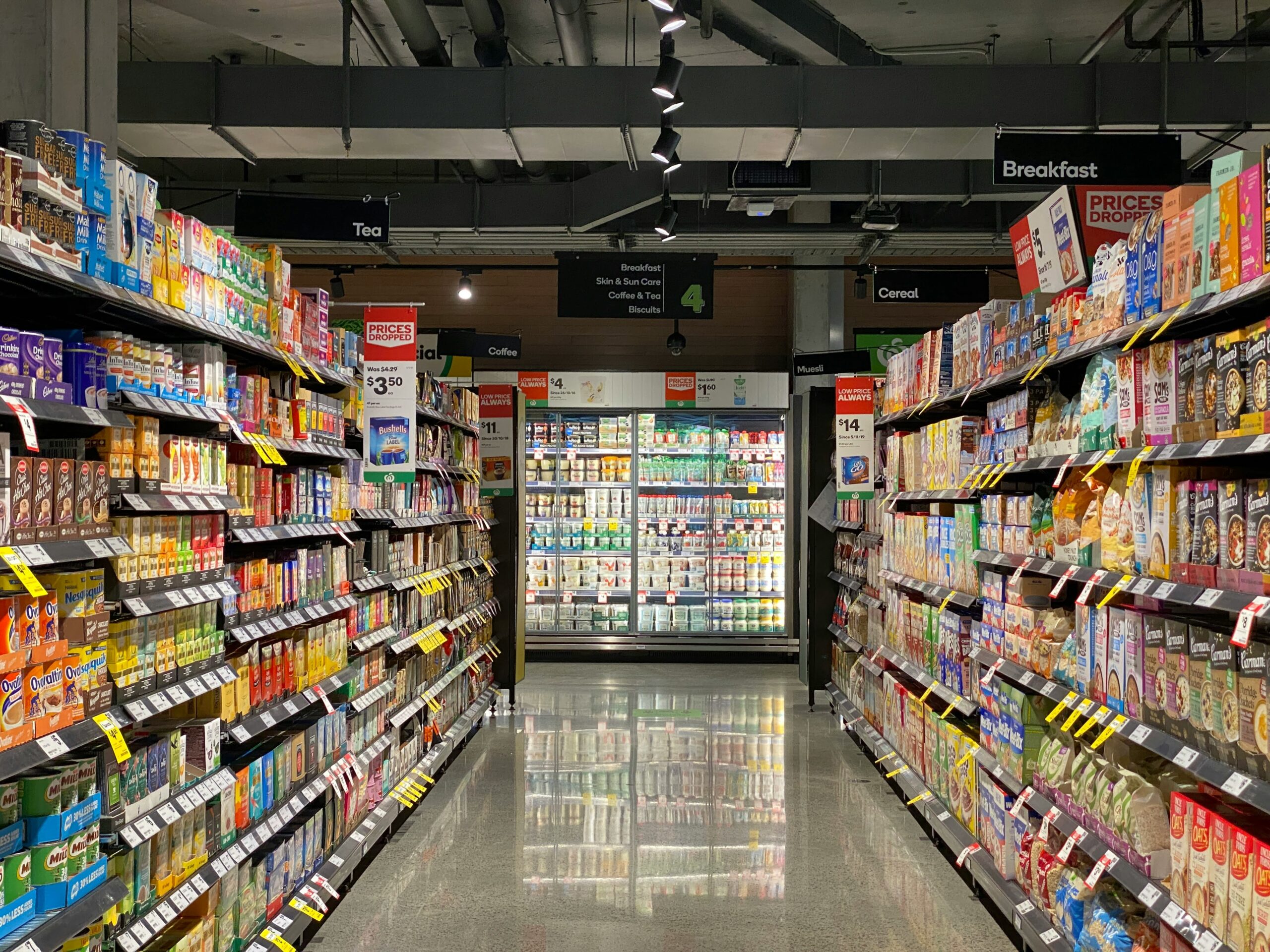
Standing in the checkout line at a Wisconsin grocery store, most shoppers aren’t thinking about government policy. They’re watching the register total climb and calculating whether the cart in front of them matches the budget in their head. But almost everything that determines what food costs — what gets taxed, who can afford to buy it, how farmers are supported in producing it, and how much help is available when incomes fall short — flows directly from decisions made by elected officials in Madison and Washington. The connection between state policy and your grocery bill is real, direct, and consequential. Understanding it is the first step toward demanding that it work better for Wisconsin families.
📋 What Wisconsin Families Need to Know
- Wisconsin exempts most unprepared groceries from the state’s 5% sales tax — a meaningful protection for working families — but prepared foods, soft drinks, and candy are taxable, and the line between “exempt” and “taxable” is more complex than most shoppers realize.
- Nearly 850,000 Wisconsin residents rely on FoodShare (Wisconsin’s name for the federal SNAP program) to help cover grocery costs — and changes in state and federal policy directly determine the size of those benefits and who qualifies.
- Trade policy — including tariffs on imported goods — functions as a hidden tax on food, raising prices at the consumer level even when shoppers never see the word “tariff” on a receipt.
- Wisconsin’s agricultural economy feeds into grocery prices statewide: state policies around farm support, Medicaid for rural hospitals, and agricultural infrastructure affect how efficiently and affordably food moves from Wisconsin fields and dairies to grocery shelves.
- Food pantry demand in Wisconsin has surged — Feeding America Eastern Wisconsin distributed 38.3 million pounds of food in 2024, up 12% from 2023 — a direct signal that existing policies are not meeting the food security needs of Wisconsin households.
How State Policies Affect Your Grocery Bill: The Sales Tax You Don’t See
The most direct state policy lever on your grocery bill is sales tax — or rather, the exemption from it. Wisconsin does not apply its 5% state sales tax to most unprepared food items intended for home consumption. That exemption covers the core of what most families put in their carts: produce, meat, dairy, bread, eggs, pasta, canned goods, and similar staple items. It’s one of the most consequential consumer protections in Wisconsin’s tax code, and one that working families depend on without necessarily being aware of it. In states that do apply sales taxes to groceries, a family spending $600 a month on food can pay an additional $30 to $50 a month in taxes — real money for a household already stretched thin.
But Wisconsin’s grocery tax exemption is not as simple or comprehensive as “food is tax-free.” Soft drinks, candy, and dietary supplements are taxable even when purchased at the grocery store. Prepared foods — items sold ready for immediate consumption — are also generally taxable. The line between taxable and exempt can be blurry in practice: a rotisserie chicken is taxable, while raw chicken breasts are not. A bottle of sports drink is taxable, while milk is not. The Wisconsin Department of Revenue publishes detailed guidance for retailers on how to classify items correctly, but from a consumer perspective, this complexity means that the effective tax rate on any given shopping trip depends on exactly what’s in the cart.
Most Wisconsin counties add a 0.5% local sales tax on top of the state rate, bringing the combined rate to 5.5% on taxable items. Milwaukee County is an exception, applying a 0.9% county surcharge rather than 0.5% — a higher rate that affects the city’s retail food environment in ways that touch the cost of taxable food items, restaurant meals, and prepared food purchases for Milwaukee residents and workers.

FoodShare: How State Decisions Shape Food Assistance for 850,000 Wisconsinites
For close to 850,000 Wisconsin residents, the grocery bill isn’t just a matter of careful shopping — it’s a question of whether the benefits available through FoodShare, Wisconsin’s name for the federal Supplemental Nutrition Assistance Program (SNAP), are adequate to cover basic nutritional needs. FoodShare is federally funded but state-administered, which means that state policy decisions — about eligibility thresholds, application processes, outreach, and supplemental state investments — determine how effectively the program reaches the Wisconsin families it’s designed to serve.
Wisconsin has made one meaningful policy choice that distinguishes it from some neighboring states: the state uses Broad-Based Categorical Eligibility at 200% of the federal poverty level with no asset test for most households. That means Wisconsin’s FoodShare eligibility is more accessible than in states with stricter income or asset requirements — a deliberate state policy decision that extends food assistance to more Wisconsin families than the federal baseline would require. The Wisconsin Quest Card, which delivers FoodShare benefits, is accepted at grocery stores, farmers’ markets, and select online retailers including Amazon and Walmart for delivery and pickup.
The stability of that system, however, is not guaranteed. Wisconsin Public Radio reported that in early 2026, Wisconsin enacted new legislation adding more than $72 million for administrative staffing to implement federal SNAP changes stemming from the federal One Big Beautiful Bill Act — changes that also include a potential restriction on using FoodShare benefits to purchase soft drinks, candy, and energy drinks. Advocates and hunger relief organizations have raised concerns about both the administrative burden of implementing restrictions and the deeper question of whether tightening benefit restrictions addresses the root causes of food insecurity, which are fundamentally about income adequacy, not purchasing choices.
Meanwhile, proposed federal budget cuts to SNAP represent one of the most direct threats to Wisconsin family grocery budgets now on the table. Feeding Wisconsin has noted that a House budget resolution included a proposed reduction in agricultural spending of $230 billion — cuts that, if implemented, would flow directly into reduced FoodShare benefits for Wisconsin recipients. Every dollar cut from FoodShare is a dollar that comes directly out of a Wisconsin family’s food budget. State leadership that actively fights those cuts — and supplements the federal program with state dollars when federal support falls short — is a direct determinant of what Wisconsin’s most food-insecure families can afford to eat.
Trade Policy and Tariffs: The Hidden Tax on Wisconsin Groceries
Not all of the policy forces shaping Wisconsin grocery bills come from the state capitol — and one of the most significant right now comes from federal trade decisions. Tariffs are taxes on imported goods, paid by businesses importing those goods and typically passed on to consumers through higher retail prices. When the cost of imported food products, agricultural inputs, or packaging materials rises because of tariff policy, grocery store prices follow — and the shopper at the checkout line absorbs that increase without any line item ever reading “tariff.”
Wisconsin Public Radio reported in January 2026 that food prices were 3.1% higher in December 2025 than in December 2024, with business and economic leaders pointing to tariff-driven cost pressures as a contributing factor. Dale Kooyenga, president of the Metro Milwaukee Association of Commerce, noted directly: “You see this in food prices, for example.” The cumulative effect is that Wisconsin shoppers are paying more at the grocery store in part because of trade policy decisions made in Washington — a reminder that grocery affordability is inseparable from the full range of federal economic policy, not just the programs specifically labeled as “food policy.”
Wisconsin’s agricultural economy has also been affected by trade tensions in ways that ripple back to consumers. Agricultural economist Chad Hart noted that 2025 was a difficult year for many crop farmers because of higher input costs, lower crop prices, and trade disruptions — including China’s reduction of U.S. soybean purchases in response to tariffs. When Wisconsin farmers are financially squeezed, the long-term stability of the state’s agricultural production — which underpins grocery supply chains throughout the region — is placed under strain.

Food Pantry Demand as a Policy Indicator
One of the most honest measures of whether food policy is working for Wisconsin families is the demand at food pantries and hunger relief organizations — because those numbers reflect the gap between what existing policies provide and what households actually need. By that measure, the current policy environment is falling short. Feeding America Eastern Wisconsin distributed 38.3 million pounds of food in 2024 — up 12% from 2023. Community food organizations across Milwaukee and the broader state have reported surging demand driven by a combination of persistent grocery price increases and federal program changes that reduced assistance for some households. Food pantries are not a substitute for adequate public policy. They are the evidence of what happens when public policy falls short.
State Agricultural Policy and What It Means at the Checkout
Wisconsin is one of the most agriculturally productive states in the country — home to a massive dairy industry, significant grain production, fruit and vegetable farming, and a growing local food movement. The policies that support or constrain Wisconsin’s agricultural economy ultimately influence the supply and cost of food that flows through the state’s grocery stores, farmers’ markets, and food distribution networks.
State investment in agricultural infrastructure — roads and bridges in farming counties, rural broadband that lets farmers manage operations more efficiently, the financial viability of rural hospitals that keep farm communities intact — all contribute to the underlying conditions that determine how efficiently Wisconsin’s food is produced and distributed. State decisions about Medicaid reimbursement for rural hospitals affect whether those hospitals stay open — and a county without a functioning hospital is a county that has a harder time retaining the farm workforce that produces the food Wisconsin families eat.
The USDA Economic Research Service tracks the relationship between agricultural support programs, food supply chains, and consumer prices — a body of research that consistently demonstrates how upstream policy decisions work their way downstream into the grocery costs that individual families experience. State governors who understand and engage with that linkage — who treat agricultural policy as food policy — govern differently than those who treat them as separate domains.
The Grocery Bill as a Lens on Economic Justice in Wisconsin
The grocery bill is not the same burden for every Wisconsin family. A household in the top income quartile spending 5% of its income on food experiences rising prices very differently from a household spending 20% or 25% of income at the grocery store. Policies that protect food affordability — sales tax exemptions on staples, strong FoodShare access, agricultural stability, and trade policy that doesn’t artificially inflate food costs — matter disproportionately for the Wisconsin families already living closest to the margin.
That asymmetry is what makes food policy a justice issue, not just an economic one. When state and federal decisions raise the effective cost of groceries — through tax policy, benefit cuts, or trade-driven price increases — the families least able to absorb that increase bear the heaviest burden. And the families most able to substitute, stockpile, or shop strategically insulate themselves from the impact in ways that lower-income households simply cannot.
A governor serious about grocery affordability for Wisconsin families doesn’t treat food policy as a narrow issue. They treat it as a cross-cutting lens on how well the state’s economic and fiscal choices are actually serving the households that depend most on getting those choices right.
David Crowley and the Grocery Bills of Wisconsin Families
David Crowley has governed Milwaukee County — a county where the evidence of food policy failure is visible every month in the lines at food pantries, in the families stretching FoodShare benefits further than they’re designed to go, and in the neighborhoods where a full-service grocery store is a bus ride away and the only nearby option charges more for less. As Milwaukee County Executive, Crowley has operated at the direct intersection of food access, public health, income adequacy, and the practical daily consequences of state and federal policy choices on working families.
The grocery bill is not an abstract policy metric. It is a weekly reality for Wisconsin families — one that is shaped, more than most people realize, by the decisions their elected leaders make in Madison and Washington. A governor who understands that connection, and is willing to use every available lever to protect food affordability for Wisconsin’s working families, makes a direct difference in how well those families eat. To learn more about David Crowley’s campaign for Wisconsin Governor, visit crowleyforwigov.com.
Frequently Asked Questions
Does Wisconsin charge sales tax on groceries?
Wisconsin exempts most unprepared food items from its 5% state sales tax — meaning the staples most families buy, including produce, meat, dairy, bread, and eggs, are not taxed at checkout. However, the exemption does not cover everything. Soft drinks, candy, dietary supplements, and prepared foods sold ready for immediate consumption are taxable under Wisconsin law. Most Wisconsin counties add a 0.5% local sales tax on top of the state rate, bringing the combined rate to 5.5% on taxable items — with Milwaukee County applying a higher 0.9% county surcharge. The Wisconsin Department of Revenue publishes detailed guidance on how specific food items are classified. Food purchased with FoodShare (SNAP) or WIC benefits is exempt from sales tax even if it would otherwise be taxable.
How many Wisconsin residents use FoodShare (SNAP) and how does state policy affect benefits?
Close to 850,000 Wisconsin residents rely on FoodShare — Wisconsin’s name for the federal SNAP program — to help cover grocery costs, according to Feeding America Eastern Wisconsin. FoodShare is federally funded but state-administered, meaning state policy decisions directly shape who qualifies and how the program operates. Wisconsin uses Broad-Based Categorical Eligibility at 200% of the federal poverty level with no asset test for most households — a more accessible threshold than some neighboring states. The state recently enacted legislation allocating over $72 million for administrative staffing to implement federal SNAP changes, including provisions related to restricting purchases of soft drinks and candy. Proposed federal budget cuts to SNAP represent an additional threat to benefit levels for Wisconsin recipients. The most current eligibility information is available through the Wisconsin Department of Health Services FoodShare page.
How do tariffs affect grocery prices in Wisconsin?
Tariffs are taxes on imported goods that businesses pay when importing products or raw materials — and those costs are typically passed on to consumers in the form of higher retail prices. When tariff policy raises the cost of imported food products, agricultural inputs like fertilizer and packaging, or other supply chain components, grocery store prices reflect those increases even though the word “tariff” never appears on a receipt. Wisconsin Public Radio reported in January 2026 that food prices were 3.1% higher in December 2025 than a year earlier, with business leaders citing tariff-related cost pressures as a contributing factor. Trade policy also affects Wisconsin farmers directly — disruptions to agricultural export markets affect farm income and the long-term stability of the food production system that Wisconsin families and grocery stores depend on.