

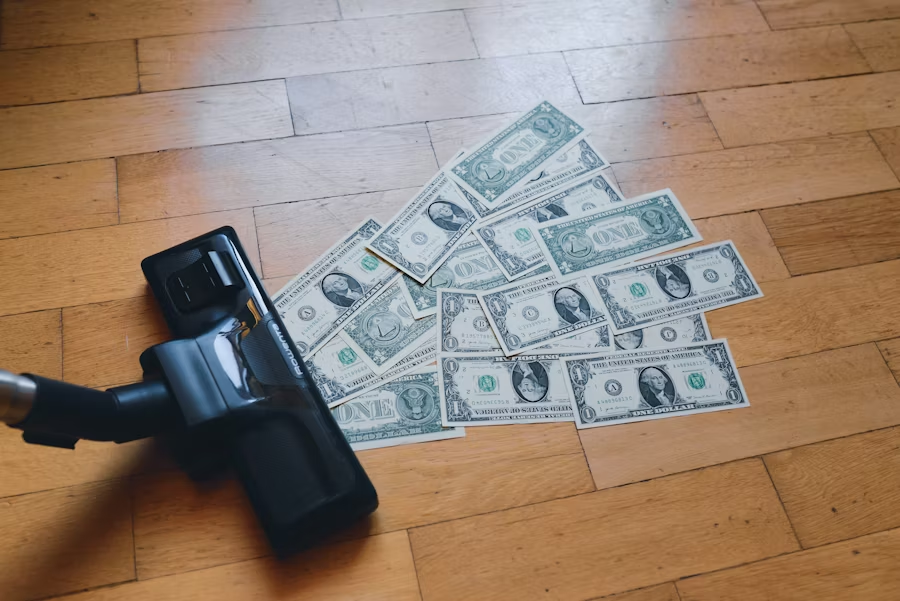
Wisconsin families didn’t need an economist to tell them something changed. It showed up at the grocery store, at the gas pump, in their rent notices, and in the gap between what they earn and what everything costs. While national headlines have moved on from peak inflation, the cumulative price increases from the past several years are still very much a lived reality for working households across the state — and the pressure hasn’t let up the way many hoped it would.
📋 What Wisconsin Families Need to Know
- U.S. consumer prices rose dramatically between 2021 and 2023 — even as inflation has slowed, prices for groceries, rent, and utilities remain elevated compared to just a few years ago.
- Wisconsin renters and first-time homebuyers face some of the most significant cost pressure, with housing affordability at decades-long lows nationally and regionally.
- Grocery prices have been one of the most persistent pain points — food-at-home costs surged faster than wages for most working families during the inflation peak.
- Lower- and middle-income Wisconsin households spend a higher share of their budget on necessities, meaning inflation hits them proportionally harder than higher earners.
- Local government decisions — on housing supply, transit, workforce investment, and public services — can directly influence cost of living for everyday residents.
What Wisconsin Families Are Actually Paying More For
Inflation isn’t one thing — it’s a compression across almost every category of household spending that happened to arrive at the same time. Data from the U.S. Bureau of Labor Statistics shows that the Consumer Price Index reached a 40-year high in mid-2022, with prices accelerating across food, energy, shelter, and goods simultaneously. For Wisconsin families, that meant no easy escape: cutting back on one category didn’t offset what was rising in three others.
Groceries stood out as a particularly sharp pressure point. The USDA Economic Research Service’s Food Price Outlook tracks grocery inflation separately from restaurant prices, and the data makes clear that food-at-home costs — meaning what families actually buy at the supermarket — climbed well above normal in 2022 and 2023. Categories like eggs, dairy, bread, and cooking oils saw some of the most dramatic increases. Even as some prices have come off their highs, grocery bills for a typical Wisconsin household remain meaningfully higher than they were in 2020.
Energy costs compounded the problem. Heating a home in a Wisconsin winter was already a real budget line — when natural gas and heating oil prices spiked, that line grew. Transportation costs rose alongside fuel prices, hitting rural Wisconsin residents and commuters especially hard, since those households have fewer alternatives to driving.

How Inflation Hits Wisconsin’s Working Families Differently
One of the most important — and least discussed — dimensions of the inflation crisis is that it doesn’t hit everyone the same way. Households with lower and moderate incomes spend a far greater share of their budget on non-negotiables: groceries, rent, utilities, childcare, and transportation. When those categories inflate, working families have almost no cushion to absorb the increase.
Higher-income households can dip into savings, delay discretionary purchases, or refinance. For a family living paycheck to paycheck, none of those options are on the table. The U.S. Census Bureau’s poverty and income data consistently shows that lower-wage workers — disproportionately women, people of color, and service industry employees — were already operating on tight margins before inflation arrived.
The Wage Gap That Inflation Exposed
Wages did rise during the pandemic recovery, but for many Wisconsin workers the raises came after — and often below — the inflation rate. When price increases outpace wage growth, workers are effectively taking a pay cut even if the number on their paycheck went up. The Economic Policy Institute’s wage tracker has documented how real wages — adjusted for inflation — eroded for large segments of the workforce during peak inflation years, with lower-wage workers absorbing the worst of it. That gap is only now beginning to close for some households, and for many, it hasn’t closed at all.
Wisconsin’s Housing Cost Crisis Is Inseparable from Inflation
If there is one category where Wisconsin families have felt the most lasting pain, it’s housing. Shelter costs — whether rent or mortgage payments — are the single largest line item in most household budgets, and they have been rising faster than overall inflation in many parts of the state.
The National Low Income Housing Coalition’s annual Out of Reach report tracks the gap between wages and housing costs across every state and county in the country. The consistent finding, year after year, is that low- and moderate-wage workers cannot afford market-rate housing without spending well above the recommended 30% of income threshold. In Wisconsin’s metro areas — Milwaukee, Madison, Green Bay, Racine — that gap has been growing.
For renters, the combination of rising rents and rising utility costs created a one-two punch with no relief valve. For would-be homebuyers, the inflation period brought a second problem: the Federal Reserve’s interest rate increases, designed to slow inflation, pushed 30-year mortgage rates to levels not seen in decades. Families who had been saving for a down payment suddenly found that the same budget could afford far less house — or nothing in the neighborhoods they’d been planning to buy in.
The result is that Wisconsin has a growing population of residents stuck in housing they’ve outgrown, paying more than they can sustain, with few good options. That’s not just a personal financial problem — it’s a workforce and community stability problem that affects every county in the state.

What Local Government Can — and Can’t — Do About Inflation
It’s worth being direct about something: a governor cannot control the Federal Reserve, global supply chains, or the price of oil. Macroeconomic inflation is driven by forces that no single state executive can unilaterally reverse. But that doesn’t mean state and local leadership is powerless — and it’s exactly the wrong lesson to draw from that limitation.
What state and local government can do is make the structural conditions better or worse for working families. Investments in affordable housing supply reduce upward pressure on rents over time. Strong public transit systems reduce household transportation costs for workers who don’t own cars or can’t afford to maintain them. Workforce development programs that move workers into higher-wage jobs improve the denominator of the affordability equation. Access to affordable childcare — a cost that has itself inflated significantly — determines whether a second earner in a household can work at all.
The Wisconsin Policy Forum, a nonpartisan research organization, has consistently highlighted housing supply constraints, workforce gaps, and public investment levels as central drivers of Wisconsin’s affordability challenges. These are areas where state-level policy decisions have a direct, if slower-moving, effect on the cost of living for everyday families.
What Inflation Has Revealed About Wisconsin’s Priorities
Every economic crisis is also a revealing moment — it shows which systems were resilient and which were fragile long before the shock hit. The inflation of 2021 through 2024 revealed that a large share of Wisconsin’s working families had been living in a kind of financial precarity that the strong economy of the 2010s had papered over. When the margin disappeared, there was nothing behind it.
It revealed that Wisconsin’s housing market was under-supplying affordable units in its most job-rich communities. It revealed that childcare was already unaffordable for many families before prices rose further. It revealed that the wages being paid in retail, hospitality, home care, and food service were too low to keep pace with even normal cost-of-living growth — let alone a surge. These aren’t new problems. Inflation made them impossible to ignore.
The question Wisconsin voters are rightly asking isn’t just “when will prices come down?” It’s “why were so many of us one bad year away from falling behind?” And the answer to that question is deeply connected to the policy decisions that have shaped the state’s economy, housing market, workforce investment, and public services for the past two decades.
David Crowley and the Case for Economic Leadership That Puts Families First
David Crowley has spent his career in Milwaukee — first as a Wisconsin State Assembly member representing the North Side, and then as Milwaukee County Executive, overseeing a budget and public service infrastructure that serves over 900,000 residents. In that role, Crowley has had to make real decisions about housing investment, workforce programming, public transit, and how county government allocates resources to the families who need them most. That’s not a policy platform — it’s a governing record.
As Crowley brings his candidacy for Wisconsin Governor to voters across the state, the inflation conversation is one that connects directly to why he’s running. The families who bore the hardest edge of rising costs are exactly the communities he’s spent his career serving and advocating for — and the structural changes needed to make Wisconsin more affordable are exactly the kind of long-horizon, systems-level work that executive leadership can either push forward or stall.
To learn more about David Crowley’s campaign and his vision for Wisconsin’s economic future, visit crowleyforwigov.com.
Frequently Asked Questions
How has inflation affected Wisconsin families compared to the national average?
Wisconsin households have experienced inflation pressures broadly in line with national trends, with grocery prices, housing costs, and energy expenses all rising significantly since 2021. The Bureau of Labor Statistics tracks Midwest regional CPI separately, which includes Wisconsin and typically tracks close to — though sometimes slightly below — national averages. Where Wisconsin families often feel unique pressure is in rural transportation costs and a housing market in certain metro areas that hasn’t kept pace with demand.
Are grocery prices in Wisconsin expected to come down in 2025?
The rate of grocery price increases has slowed significantly compared to the 2022 peak, but that doesn’t mean prices are going back to 2019 or 2020 levels. Most food economists distinguish between inflation (the rate of price increase) and price levels (the actual cost). The USDA’s Food Price Outlook projects that food-at-home price growth will remain modest in 2025, but the cumulative price increases from the past several years are largely permanent. Wisconsin families should expect their grocery budgets to remain higher than pre-pandemic norms for the foreseeable future.
What can Wisconsin’s governor actually do to help families with the cost of living?
While no governor can control national inflation, Wisconsin’s executive has meaningful levers. The governor sets the legislative agenda, proposes the state budget, and can prioritize or defund programs that directly affect household costs. Specific areas where state leadership matters include: expanding affordable housing supply through zoning reform and state investment, increasing access to subsidized childcare (which directly enables more households to earn two incomes), investing in public transit to reduce transportation costs for workers, and ensuring that state workforce programs connect workers to higher-wage careers. These aren’t quick fixes — but they are the structural interventions that determine whether Wisconsin becomes more or less affordable over the next decade.